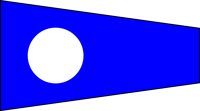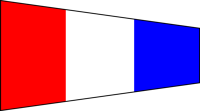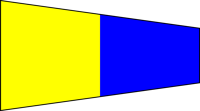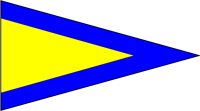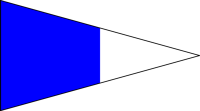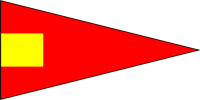


Did you know? The navy has a flag alphabet. Every letter or number has a meaning. The flags form a language. On their own or in combination with others, they indicate a situation.
The best-known are the A (Alpha flag), which means: “I have divers underwater”, but the Q (Quebec flag) is also well known, as it must be hoisted when entering a new country to request customs clearance...
Today, in the age of easy communication, the flag is completely outdated. Nevertheless, it retains the charm of traditional seafaring. And a bit of nautical culture never goes amiss.
A (Alpha) flag

Alpha flag – There is a diver underwater; keep your distance and proceed slowly.
An alternative flag is the Michigan flag, which is used in the USA and Canada, for example. Both flags are often displayed at the same time.
B (Bravo) flag

I load, unload or transport dangerous goods.
Its purpose is to warn other users of the waterways whilst dangerous goods are being handled.
C (Charly) flag
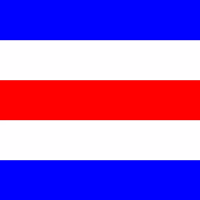
Yes (affirmative answer), or the preceding group is to be understood as a statement. .
Distress: Together with Flag November (N over C) = ‘I am in distress and require immediate assistance’.
D (Delta) flag

Don’t get in my way; I’m having difficulty manoeuvring.
Warns other vessels that the vessel is unable to manoeuvre or has limited manoeuvrability.
E (Echo) flag

I’m coming to starboard.
It is used as a signal flag on boats and ships to visually communicate intentions regarding manoeuvres.
F (Foxtrott) flag

I’m at a loss – please get in touch.
The ship is unable to manoeuvre and is requesting contact.
G (Golf) flag

I need a pilot; From a fishing boat: ‘I’m hauling in my nets’
When used by fishing boats in the vicinity of other boats, it means: ‘I’m hauling in my nets’.
H (Hotel) flag
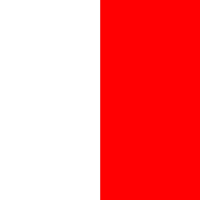
I have a pilot on board.
Uses: shipping, ship-to-ship communication, port operations.
I (India) flag
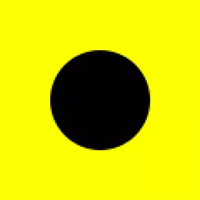
I’m coming to port side
It is used as a signal flag on boats and ships to visually communicate intentions regarding manoeuvres.
J (Juliet) flag

I am on fire and have dangerous goods on board.
Keep your distance – I have a fire on board and am carrying dangerous goods, or I have a leak involving hazardous substances.
K (Kilo) flag
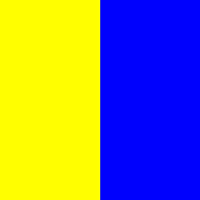
I would like to communicate with you, or I am inviting you to send a signal.
At sea, it is therefore used to establish contact between ships.
L (Lima) flag
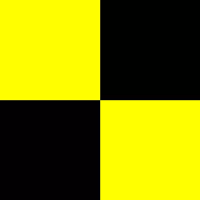
Stop your ship immediately.
In port, it signals a quarantine (often in conjunction with the ‘Quebec’ signal), whilst in regattas it means: ‘Come within calling distance’ or ‘Follow me’.
M (Mike) flag
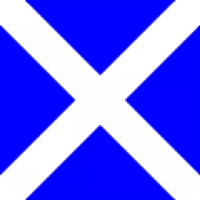
My ship has come to a halt and is no longer adrift.
It signals to other ships that it is stationary, i.e. moving neither forwards nor backwards.
N (November) flag
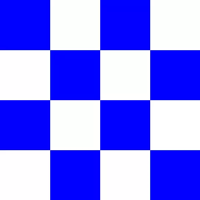
No (negative answer), or the above signal is to be understood in the negative sense.
Distress: If the ‘N’ flag is hoisted above the ‘C’ (Charlie) flag, this signals an international distress signal (Mayday).
O (Oscar) flag
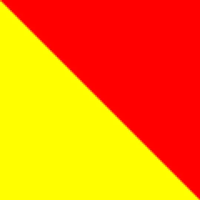
Man overboard.
It serves as an urgent distress signal to warn other vessels and request assistance.
P (Papa) flag

In port: All persons on board must report their presence; the vessel is about to set sail.
On the high seas, however, it means that a fishing vessel’s nets have become entangled in an obstacle.
Q (Quebec) flag

It signals a request for permission to enter port, as there are no infectious diseases on board.
Warning: When flown in combination with other flags (e.g. the L-flag), the Q-flag means ‘My ship is infected’.
R (Romeo) flag
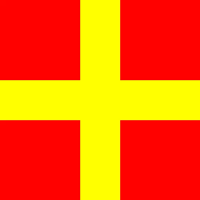
At-sea replenishment (Navy): Hoisting the Romeo flag (often in combination with other flags such as Bravo) indicates that the ship is unable to manoeuvre, or that its manoeuvrability is restricted, as it is currently being replenished.
S (Sierra) flag

I am using ‘Reverse’ / ‘My machine is reversing’.
This is a safety feature designed to prevent collisions caused by unexpected manoeuvres.
T (Tango) flag
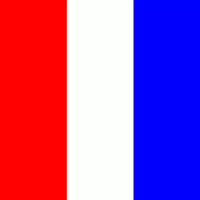
A request to other vessels to keep their distance, as the vessel is actively fishing with a trawl net as part of a pair (two vessels).
It is issued by one of the two vessels fishing together.
U (Uniform) flag
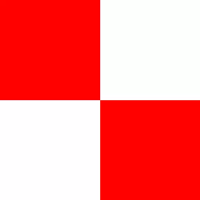
The ship is signalling to others that their course is dangerous.
Used when ships are navigating in shallow waters or near obstacles.
V (Victor) flag

I am asking for support / help.
Used in accordance with the International Code of Signals, often in combination with other flags to clarify the nature of the assistance required.
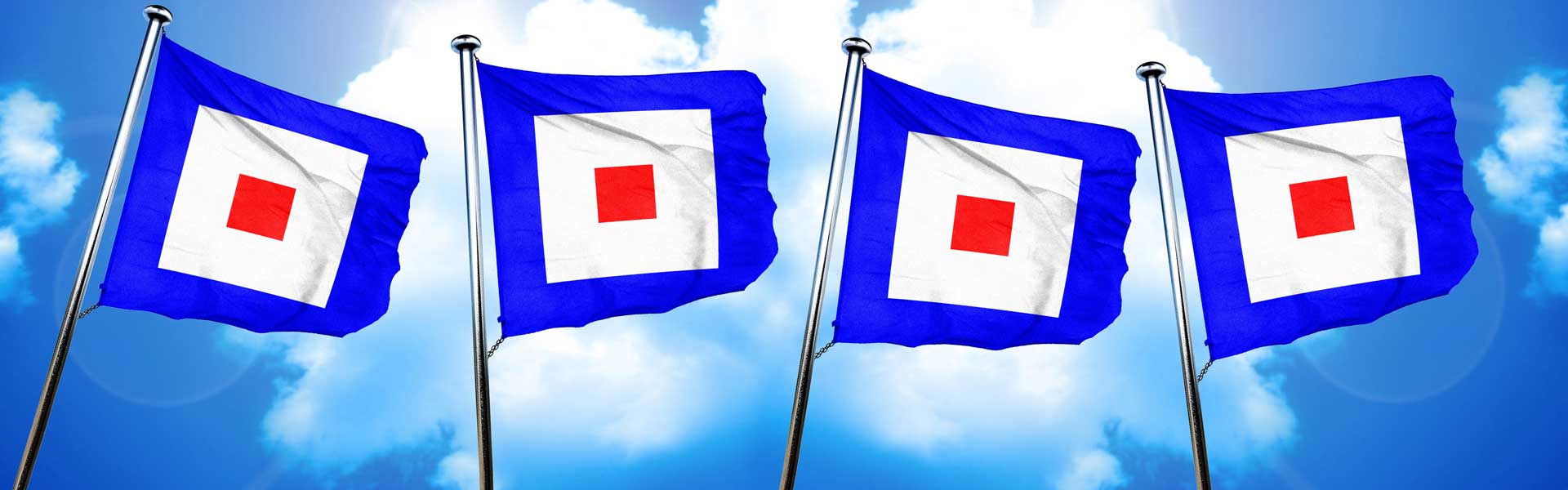
W (Whiskey) flag

Medical assistance required.
It is used as a single signal to indicate a need for medical assistance to passing vessels or coastal stations.
X (X-ray) flag

Stop your manoeuvres and watch for my signals.
A request to other vessels to stop any manoeuvres they are carrying out and to watch for further instructions.
Y (Yankee) flag
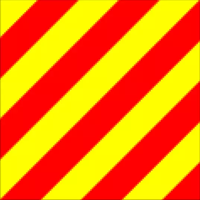
My anchor is dragging.
Warning: This signals nearby vessels to keep their distance to avoid collisions.
Z (Zulu) flag

I need a tugboat. “From a fishing vessel”: I’m lowering my nets into the water.
The flag is hoisted in emergencies, when the vessel is unable to manoeuvre, or during specific operations.
Michigan diving flag
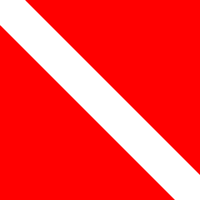
The Alfa flag is prescribed by the Collision Prevention Regulations (CPR) for international waters.
Whilst the laws of many US states and Canada require the red-and-white Michigan flag, the US Navy continues to use the Alfa flag.
NC (Distress signal)
The multi-flag signal ‘NC’ is an internationally recognised distress signal. In this signal, the flags are displayed one above the other.
UW (Have a safe journey)
The signal flags U and W mean ‘Safe journey!’. Here, too, the flags are displayed one above the other.