


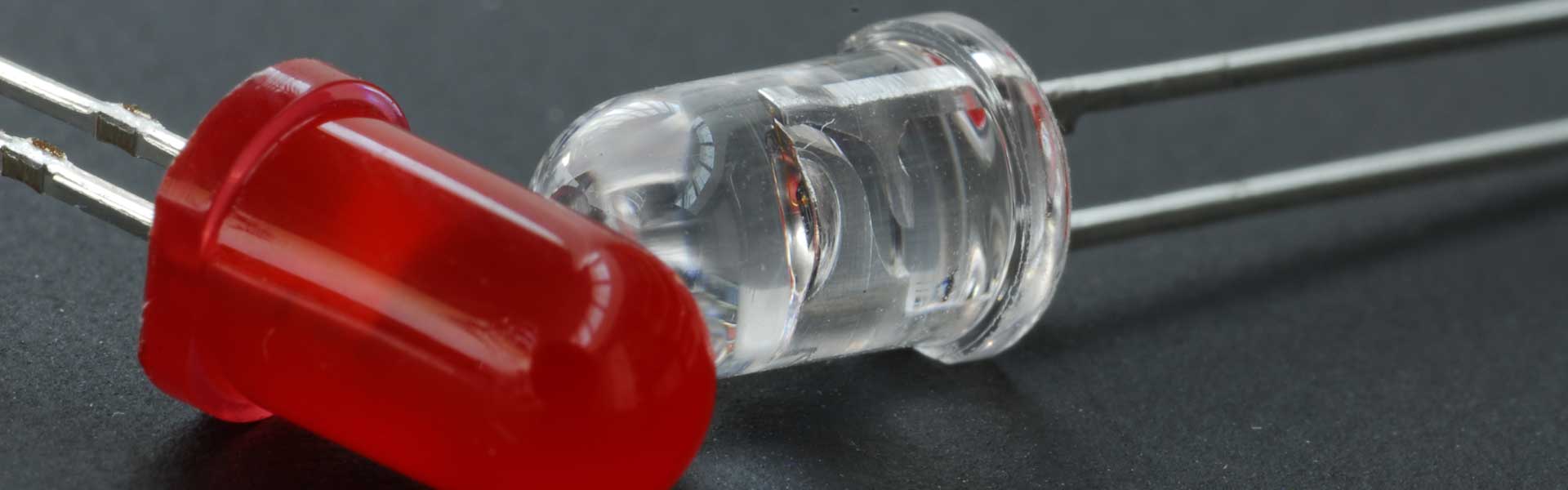
Unlike incandescent bulbs, LEDs must never be connected directly to a voltage source without current limiting. This refers to individual LEDs, such as 3mm, 5mm, SMD, etc. This can be recognised by the fact that no ‘rated voltage’ is specified for these components. Instead, the parameters ‘forward voltage’ and ‘forward current’ are specified. For single-chip LEDs, the forward voltage depends primarily on the light colour. Care must be taken to ensure that the forward current is not exceeded under any circumstances. Otherwise, the LED will be destroyed.
Incidentally, this does not apply to products where the LEDs are already integrated and connected to series resistors or constant-current sources. In such cases, the ‘rated voltage’ is specified directly, e.g. for LED strips.
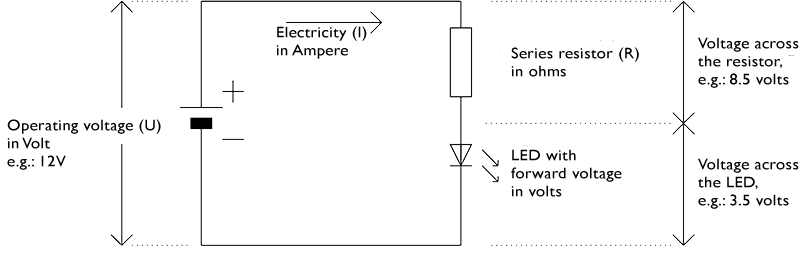
Series resistors are generally used to set the forward current for the LEDs. The resistance value is calculated according to Ohm’s law as follows: the voltage drop across the resistor divided by the forward current of the LED.
The available operating voltage, the LED’s forward voltage and its forward current are, of course, known. The voltage drop across the series resistor is given by the difference between the operating voltage and the LED’s forward voltage.

Incidentally, if several LEDs are connected in series, their forward voltages add up. The forward current always remains the same in a series connection.